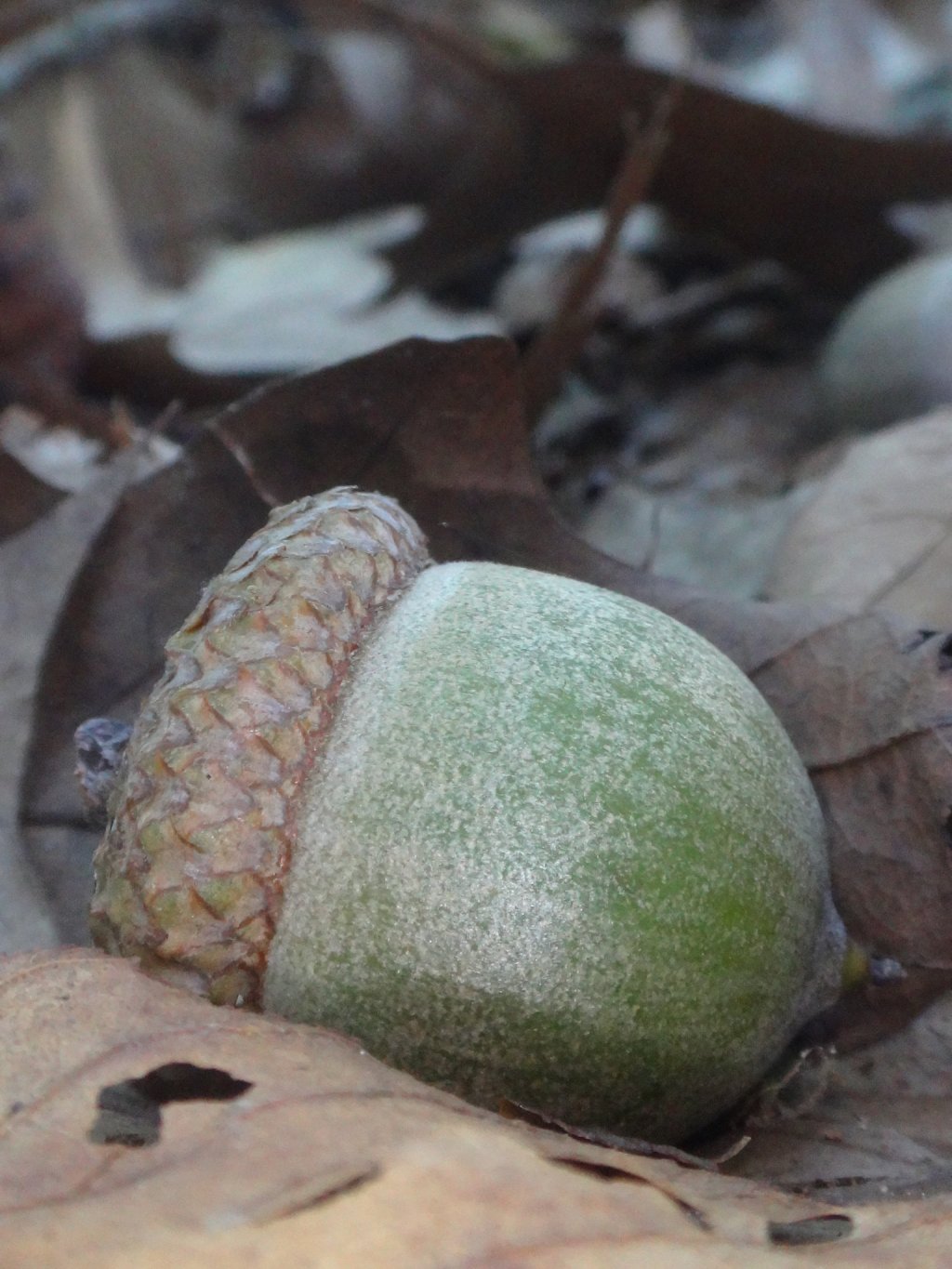
The second group of trees we are going to cover in our Seeing the Trees Through the Forest series will be covering different species of Red Oaks. Last week we covered different species of White Oak. There are many similarities between white and red oaks, and every oak is a good oak for the health of wildlife that lives in deciduous forests.
Red Oaks, like White Oaks produce acorns that are a preferred food source for many forest inhabitants, some species of acorn more than others. Consider any acorn producing tree a food source for game animals including white-tailed deer and bear. Low foliage is also a source of browsing for white-tailed deer and rabbits. Porcupine have been noted to feed on the bark of Oak trees. Even Ducks have been known to feed on some of the smaller acorns produced by Red Oaks during migrations. 1
Red Oak acorns (just like white oak) can be eaten by humans raw or cooked. Most species have tannins that should be leached out to improve the flavor. Leaching can be done by thoroughly washing the dried and ground up seed in water. 2
Scarlet Oak – Quercus Coccinea
Scarlet Oak has scaly bark with narrow, broken up ridges separated by narrow, deep cuts. Scarlet Oaks live around 200 years and can be found on ridges and high slopes on mostly dry, well drained sites. 1
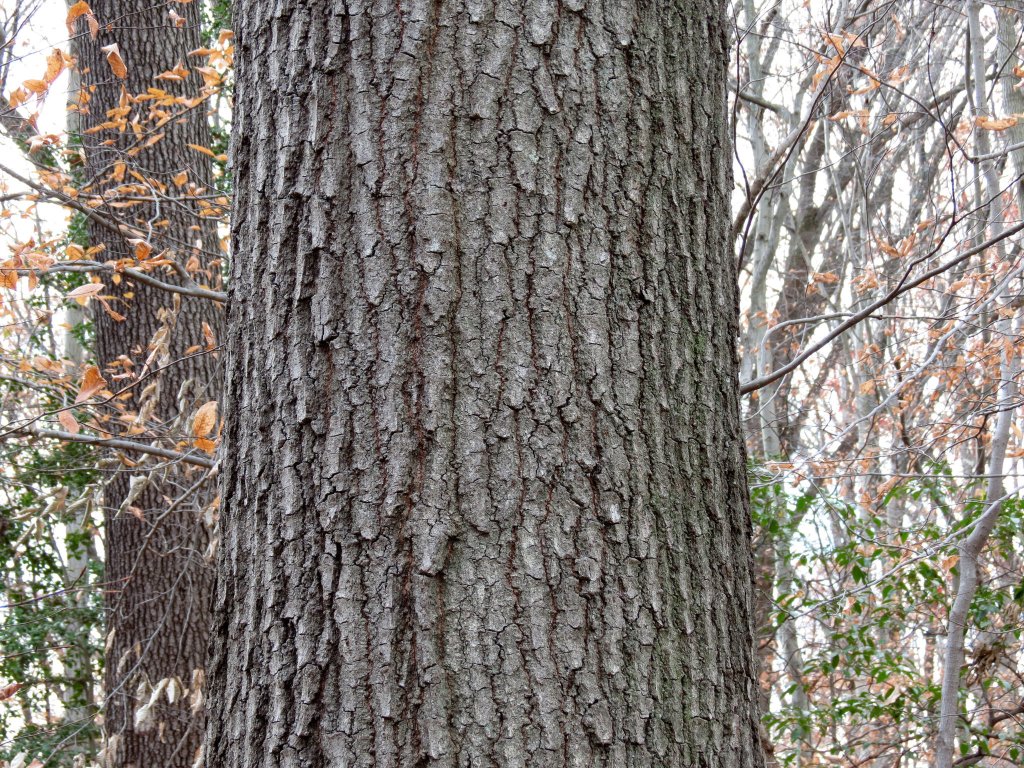
Photo © Katja Schulz
CC BY 4.0.
Scarlet Oak leaves have around 5-9 lobes, with deep ‘C’ shaped sinuses. Lobe points curve away from each other. Leaves do not have any kind of hair or fuzzy feel. Scarlet Oak get their name from the scarlet red colored foliage they develop in the fall. 1

Photo © Doug Goldman,
CC BY 4.0.
Scarlet Oak acorns are very small with a cap covering about half of the acorn. Acorn caps have very tight scales and the acorns have rings of depressions near the tip. Acorns are produced after about 20 years. 1

Photo © Chris Kratzer,
CC BY-SA 4.0.
Bear Oak (Scrub Oak) – Quercus Ilicifolia
Bear Oak have a sprawling growth habit, growing more horizontal than upright with multiple trunks. Individual stems typically live 20-30 years in dry, barren, usually sloped sites like mountaintops and ridges. Root systems can survive much longer and can resprout vigorously. 1
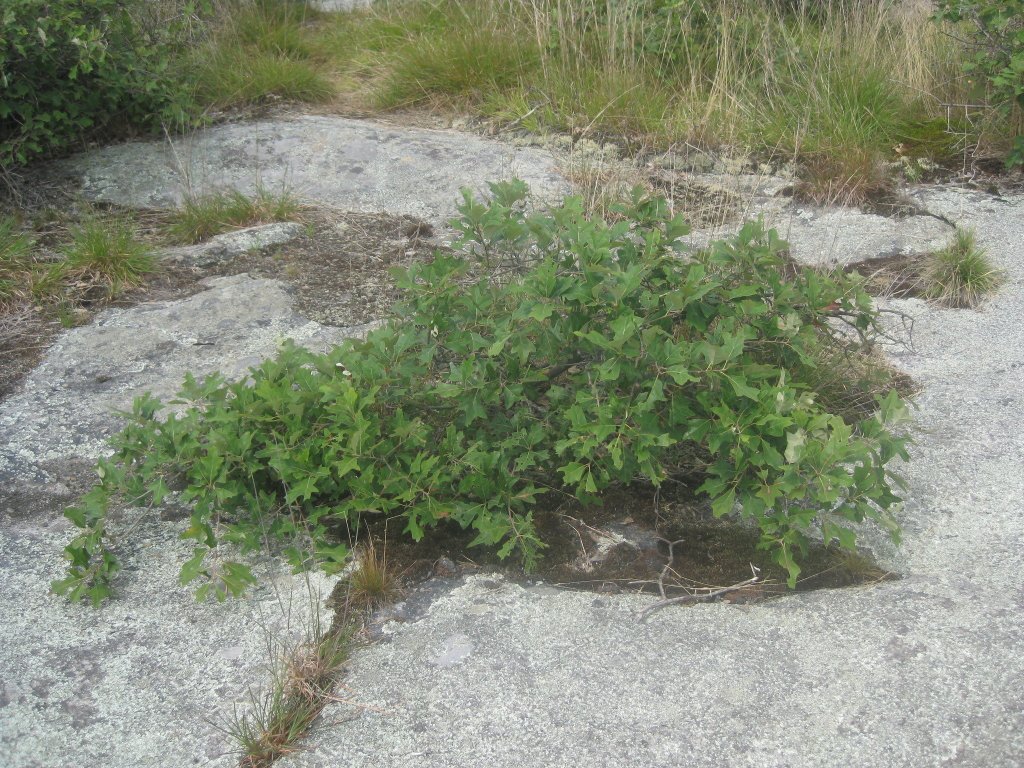
Photo © ttadevosyan,
CC BY 4.0.
Bear Oak leaves have 3-7 lobes that come to few points, often just one. Leaves can have a lobe at the base. Leaves are pale underneath, contrastingly strongly with the top of the leaf and have dense hairs underneath. Bear oak foliage is orange to purplish red in the fall. 1

Photo © Doug Goldman
CC BY 4.0.
Bear Oak acorns have caps that cover 1/3rd to 1/4th of the acorn. Acorns have a generally flat base and average on the smaller side of acorns. 1
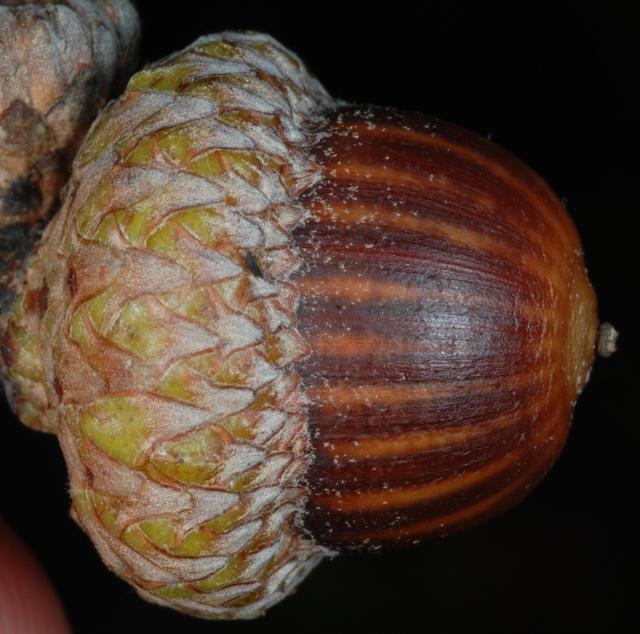
Photo © Doug Goldman,
CC BY 4.0.
Pin Oak – Quercus Palustris
Pin Oaks have lower branches that strongly descend, middle branches that are generally horizontal and upper branches that ascend. Light Gray bark, scaly with narrow ridges and furrows but overall smooth for an Oak. Pin Oaks live around 200 years and can be found in wet, poorly drained sites like floodplains, bottom lands or poorly drained areas in upland habitats. 1
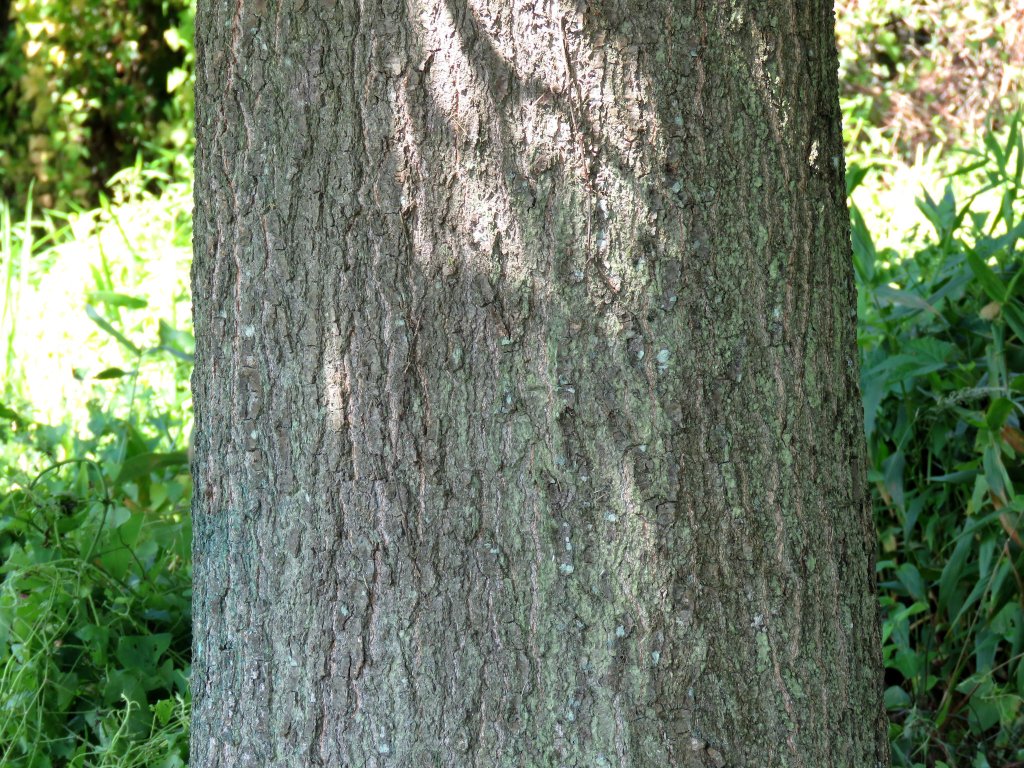
Photo © Katja Schulz,
CC BY 4.0.
Pin Oaks leaves have 5-7 lobes with deeply cut sinuses. Lobes near the base of the leaf are mostly perpendicular. Lobe tips generally all point in the same directions. Foliage russet, bronze reddish in the fall. 1
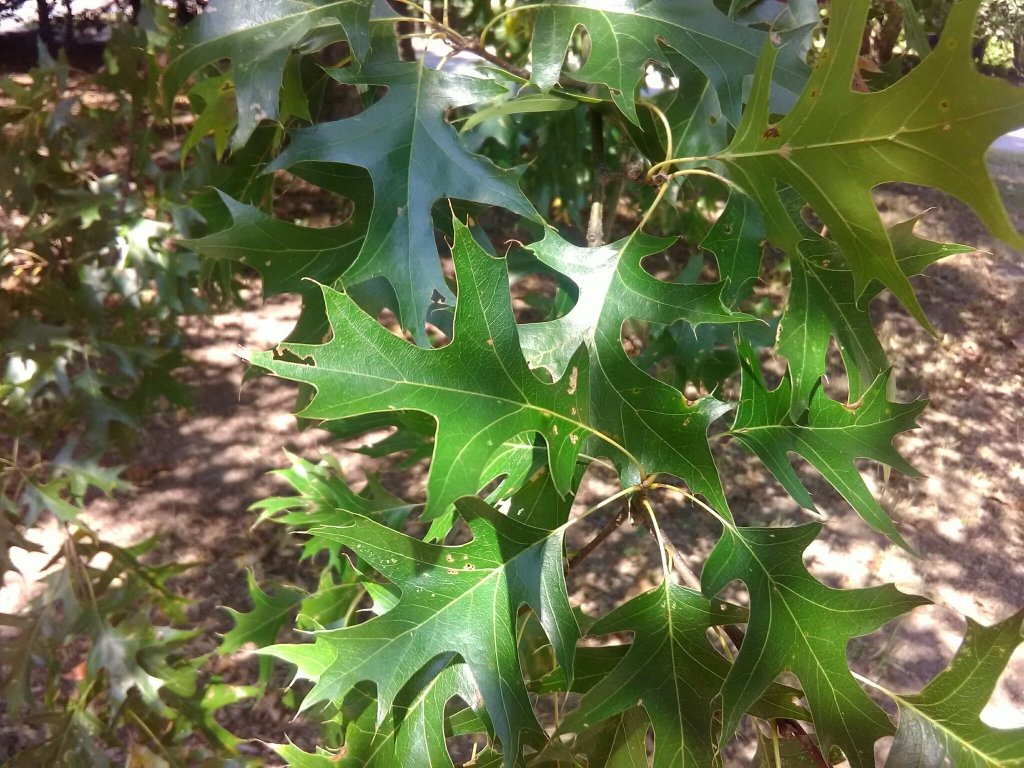
Photo © Claire Secrist
Public Domain.
Pin Oak Acorns have a stout appearance with a thin cap that is relatively flat and covers only a thin part of the acorn. Pin Oaks produce acorns after about 20 years. 1
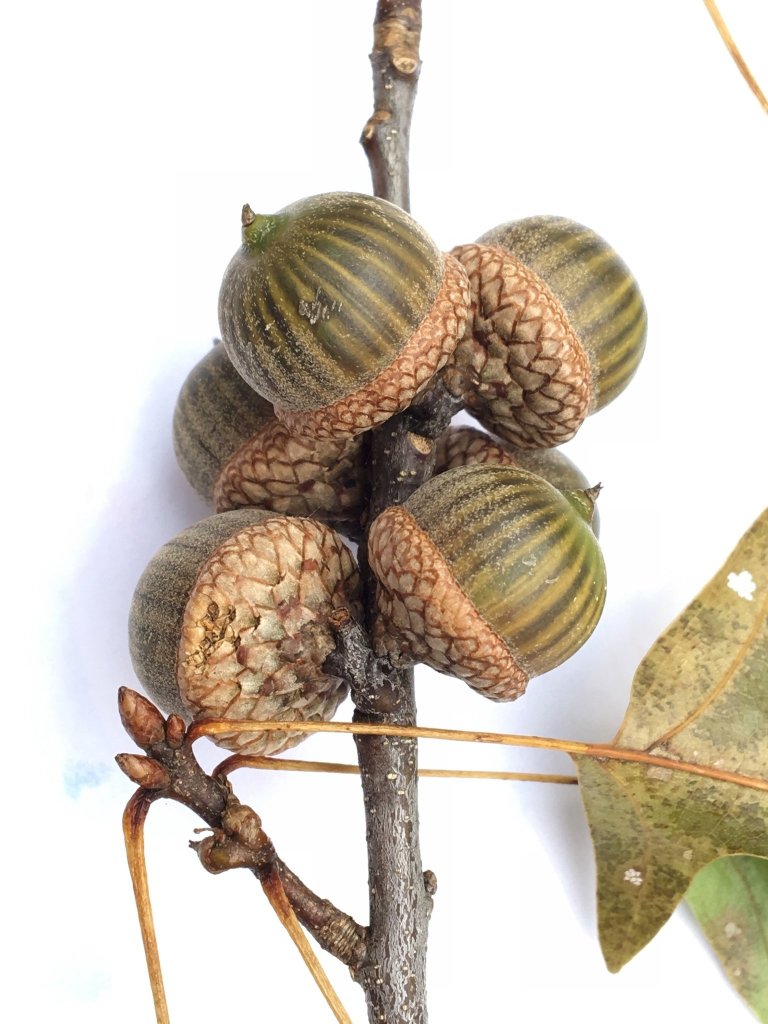
Photo © Ron Burkert
CC BY 4.0.
Northern Red Oak – Quercus Rubra
Northern Red Oaks have smooth pale gray outer bark with long unbroken ridges with valleys that are rougher and darker than the outer bark. Large, heavy branches and has a habit of self pruning lower branches. Northern Red Oaks can live around 400 years and are primarily found in forests, often as a dominant species. Most common in rich, dry woods that have good drainage. 1

Photo © Katja Schulz
CC BY 4.0.
Northern Red Oak leaves have 7 – 11 lobes with sinuses that extend slightly less than halfway to the mid rib. Lobes typically point to the tip of the leaf. Red – Reddish brown foliage in the fall. 1

Photo © Andrew Conboy
CC BY 4.0.
Northern Red Oak Acorns are large, stout acorns with a cap that covers 1/4 to 1/3 of the acorn. Acorns are produced by the Northern Red Oak after about 25 years. 1
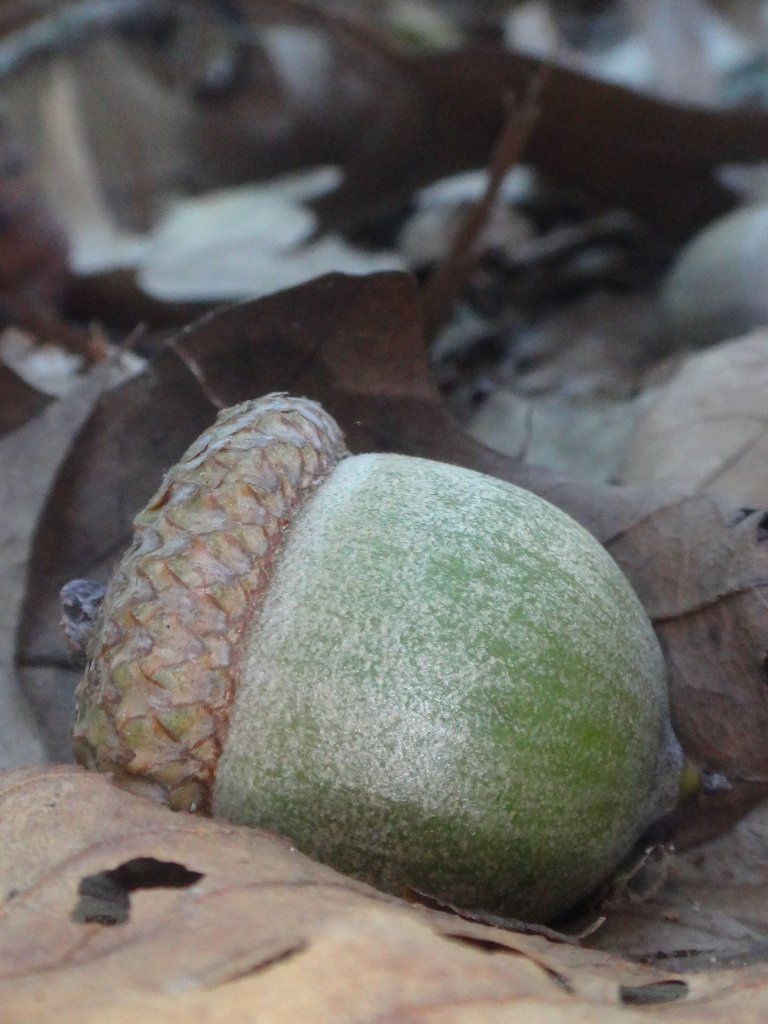
Photo © Chris Kratzer
CC BY 4.0.
Black Oak – Quercus Velutina
Black Oak overall have very variable appearances and can be hard to identify. Overall the bark is rather rugged and fragmented. Black oaks live around 200 years and can be found in a variety of sites but typically on dry upland sites in sandy sunny sites. Can out compete other vegetation on sandy, course soils and favors south and west facing slopes. 1

Photo © Even Dankowicz
CC BY 4.0.
Black Oak leaves can have small hairs on it and are variable in shape. They can be very broad with shallow sinuses and a squared shape to the lobes. The leaves can also have deep sinuses that form a ‘C’ Shape. Lobes are pretty evenly distributed. Yellow, Orange Brown foliage in the fall. 1

Photo © Andrew Conboy
CC BY 4.0.

Photo © Even Dankowicz,
CC BY 4.0.
Black Oak acorns are fairly small with the cap enclosing half or nearly half of the acorn. Scales of the acorn cap loose and can curve outward. Black Oaks produce acorns after about 20 years. 1

Photo © Laura Gaudette
CC BY 4.0.
Citations: (View Citation Page links)
 Wild Heritage Horizons
Leave a comment