Have you ever seen anything while hunting that clues you into activities taking place when humans aren’t in the area? I’d say almost all hunters would say that they wish they could keep their eyes on something 24/7 that they stumbled upon in the woods, either a dug out hole, that could be a den or a burrow, maybe even a scrape or rub from a buck. If only there was a way to see what might be active in an area when you can’t be physically present. By now you’re probably thinking “Yeah… it’s called a trail camera” and potentially calling me a rude name. You would be correct.
In a field where I hunt Turkey in the spring and Pheasant in the fall, there stands a lone Swamp Oak tree that grew wide and round as is its natural course when left in a open clear area. I always gravitated toward this tree, standing alone as the only source of cover when hunting or shade when scouting in the warmer months. This tree became even more curious the more I visited it.
One of the first curiosities I found were a number of turkey wing feathers. At first I thought that this might be a roost tree for Turkeys, but dismissed that idea the more I looked around. On another trip I found Pheasant feathers while out hunting for the same bird. I didn’t think much of it, just that another hunter had better fortune than I at the tree. The next trip though, I found not only Pheasant feathers but the leg of a pheasant. Now that was odd to me, why would a hunter butcher a bird in the field? If they had, why wasn’t there more evidence of it besides just one rather roughly removed leg? This began my suspicions that there was something else going on here then a turkey flying or a hunter harvesting a pheasant.
The following time I visited the tree I had a friend with me and told him that I had seen some signs that animals had been killed at that tree. As we approached the tree, the breeze would blow the scent of skunk our way occasionally. When we arrived we found skunk fur not only on the ground around the tree but on the first branch of the tree that was very wide and flat about 7 feet off of the ground. As we looked closer we found feathers on the tree branch as well. Now I was very curious. We made the decision to go grab a ladder and a trail camera and leave it in the tree above the large, lower branch to see onto it and see what was going on at the great swamp oak tree.
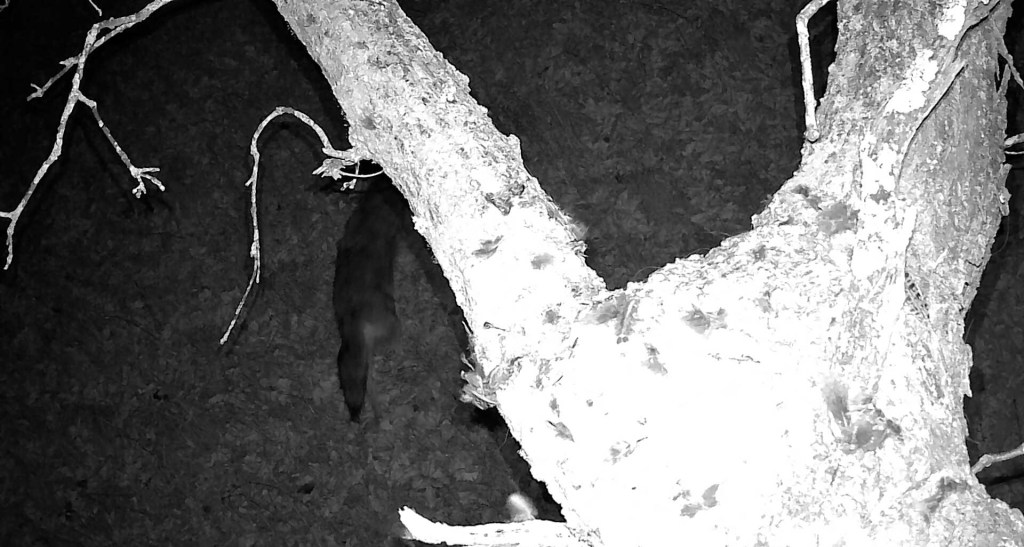
We returned with the necessary equipment and set our surveillance on the branch. A few nights went by and I started getting pictures of mice running about in the tree at night and birds fluttering around during the day. Then a picture of this large Coyote under the tree came through. Although its cool to see, it definitely doesn’t answer where all the feathers in the tree came from.
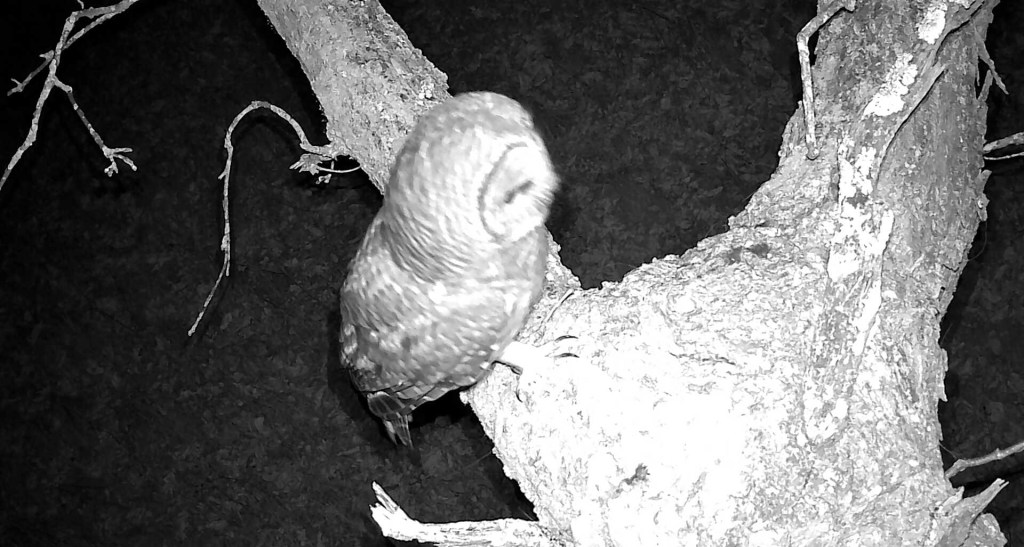
After another couple of nights, I received the below picture of a Barred Owl sitting on the branch. This was very exciting to see and potentially an explanation for what was eating in the branch. Although I know owls are exceptional predators, I wasn’t sure this size could’ve been the one killing and eating animals the size of a skunk or a pheasant.
The skunk fur found in the tree is really what made me think about what could be the predator lurking in the Oak tree. Skunks are preyed upon by mammals like Coyotes, Foxes, Bobcats and even Fisher. I didn’t think a Coyote or a Fox would go through the trouble of getting straight up a large oak tree to eat a skunk, A Bobcat or a Fisher are more probable options to perform such a feat. But there is one other predator of the skunk that would be inclined to eat in a branch, rather than on the ground. Owls have been known to prey on skunks, but I believe one larger than the Barred Owl above would have to be involved. Then it finally showed itself.
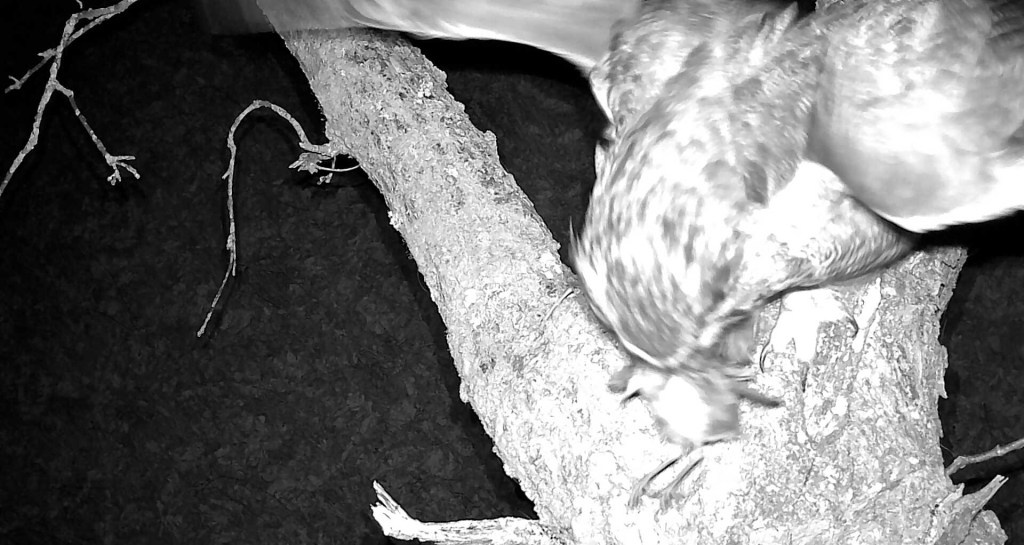
What appears to be a Great Horned Owl brought a bird for dinner on the branch. Now this is a predator capable of taking down a skunk or a pheasant without any issue and bringing it into a tree branch. In fact, the bird proved it to us a few nights after, when it actually brought what looks to be a pheasant into the tree.
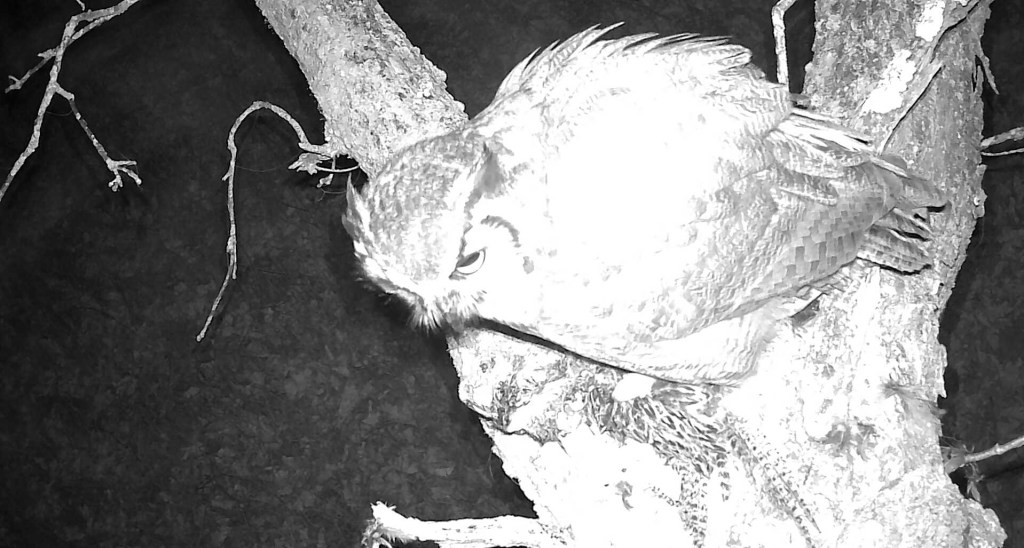
Over the next few weeks we will share a few pictures and videos of the Great Horned Owl eating in the same branch, on various nights. Follow along on our social media to see more from the Owl Tree!
 Wild Heritage Horizons
Leave a comment